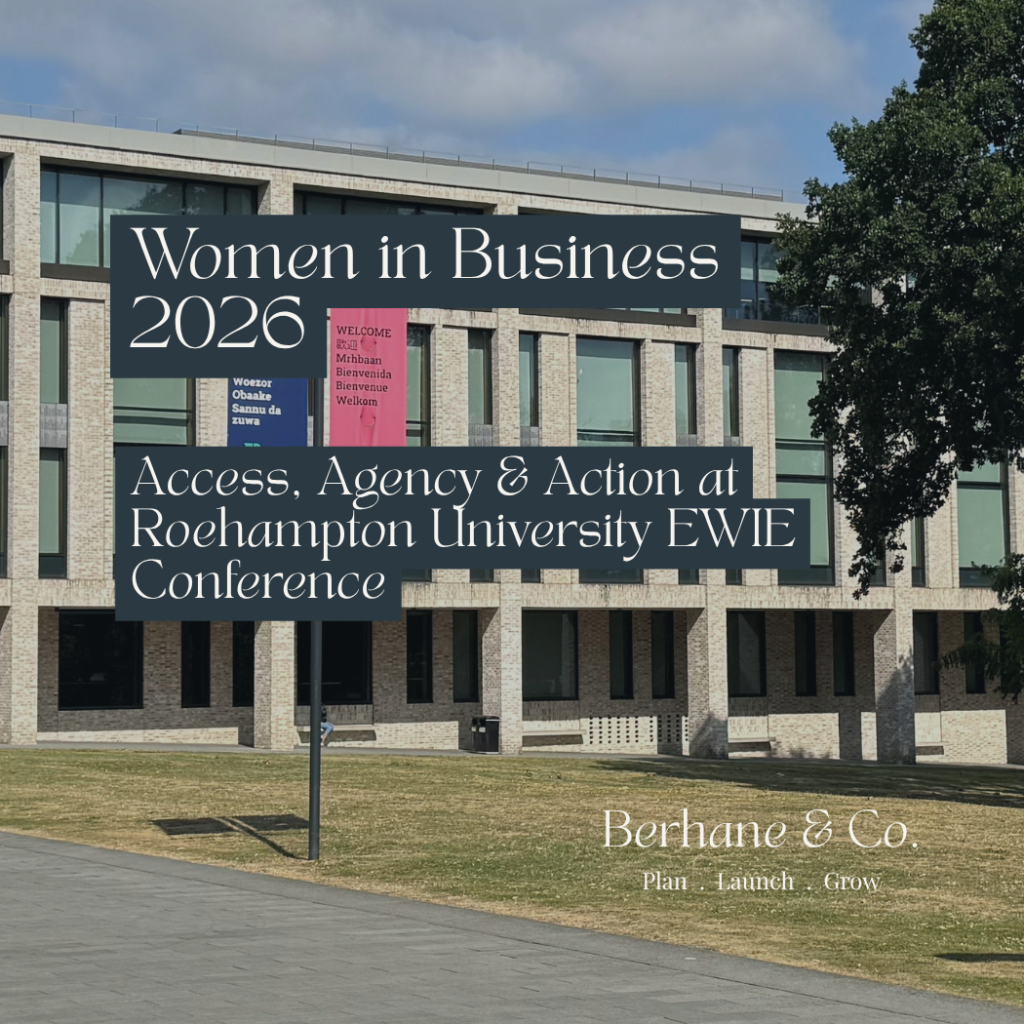
Women in Business 2026 Access, Agency & Action at University of Roehampton EWIE Conference
Five things every woman in business can learn from EWIE 2026
The Empowering Women in Entrepreneurship Conference (EWIE) returned to the University of Roehampton for its third year on 13th July 2026. Hosted by The Business Laboratory, University of Roehampton under the leadership of Bari Malik, this year’s conference brought together delegates, entrepreneurs, academics, policymakers, students and investors from across the UK and internationally. With 133 registrations, 78 attending in person and 48 joining online from 11 countries across Europe, Africa and Asia, the EWIE conference has now welcomed over 500 attendees across its three years.
I had the privilege of speaking on the Policy, Networks and Enterprise Ecosystems panel alongside some extraordinary women. Here is what the conversations in that room revealed and five things every woman in business can take from EWIE 2026.
For every woman in business in 2026, the theme could not have been more timely; Access. Agency. Action. From Opportunities to Outcomes
Access; providing access to networks, finance, knowledge and opportunity for women-led businesses, founders, professionals and students.
Agency; supporting women to exercise leadership, confidence, choice and control throughout their entrepreneurial journeys.
Action; translating dialogue, visibility and insight into tangible enterprise outcomes, partnerships and progression.
Access. Not just funding, but also access to the room
The access conversation at EWIE went far deeper than grants and loans, although those conversations were had and they were important.
Angie Madara, Founder of Athena FundX, opened with a session titled 1.6% Is Not Acceptable: Unlocking Capital for Women Entrepreneurs. That number has since fallen further. Recent reporting puts equity investment in all-female founding teams at just 1.3%, a figure that has barely moved in a decade despite every conversation, every conference and every report calling for change
That statistic, such a small % of venture capital going to women in business, is a number that should be impossible in 2026 and yet there it was. Named. Challenged. Refused.
Women approaching banks for business loans are still being treated differently to their male counterparts. That is not conjecture. That is the experience shared openly in that room by founders who have lived it. Access to funding remains one of the most significant barriers for women entrepreneurs, particularly those who are self-funding, bootstrapping and making it work without the safety nets that others take for granted.
But access is not only about money. It is about visibility and being in rooms that allow you to better yourself. Access to the networks that create opportunities, support and connections you could not have manufactured alone. The knowledge and experience of a peer group that changes how you see what is possible. The founders, trailblazers and mentors who have walked the path before you.
Access means being in a space where your story is understood before you have even told it. Where you do not have to explain the context of your experience before making your point. Where the barriers, visible and invisible, are named rather than politely ignored.
That is what EWIE 2026 was and it matters more than it is possible to overstate.
It was also a personal joy to return to Roehampton after all this time.
Agency. Not letting your circumstances predetermine your destination
One of the phrases that ran through EWIE 2026, said in different ways by different voices across the day, was start with yourself. It may be one of the phrases of 2026!
Not start when conditions are perfect. Not start when you have permission or when someone else confirms you are ready. Not when the funding comes through, the childcare is sorted, or the timing finally feels right. Start with yourself. Start with what you have. Start from exactly where you are.
You can start from humble beginnings. You can start small. To become more than what the stereotypes or the statistics suggest is possible for you? You have to just start. On a solid foundation. With intention and refine in motion.
This is agency and it was everywhere at EWIE.
It is in the story of motherhood, of parenting whilst doing the work and building something of your own when the world is simultaneously asking you to show up everywhere else. It is in navigating race and representation, of rarely seeing yourself reflected in the stories of who gets to be an entrepreneur and choosing to write a different story anyway. It is in the decision, made quietly and repeatedly, not to let your circumstances predetermine your destination. To dream and to build.
Rachel Wang, Co-Founder and CEO of Chocolate Films, whose company was awarded the Royal Warrant, spoke on storytelling, creativity and entrepreneurship. Her journey is itself the argument. She did not wait for the door to open. She built the door, then she built something so good the King noticed.
Mary Pagano, CEO and Founder of Hera Media Group, brought a perspective shaped by 25 years as the only woman in the room at Fortune 30 companies including Motorola and AT&T. Managing businesses valued from $100 million to $3 billion whilst consistently being the lone female voice at the table. Rather than be defined by that she built something of her own. Hera Media Group exists to empower women globally through media, education and the Eat Earn Learn programme, a practical, accessible route to economic independence for women who have been systematically excluded from it. Mary is also a board adviser on Hera City, an ambitious smart city project with connections to Morocco, which represents a vision of technology-led development designed with women and community genuinely at its centre. Not as an afterthought but from the beginning.
Roseita Royce, CEO of Big Ben Studios at Pinewood Studios and President of the British Film Festival, brought the power of storytelling to the conversation. A filmmaker whose work is driven by a belief that film can teach the world to live in peace; she spoke about a project currently in fundraising, one where the community at the centre of the story is not simply it’s subject but active participants in telling it. People who are too often overlooked, misrepresented, or defined by their circumstances rather than their humanity. The opportunity to be seen on your own terms. To have agency over your own narrative. To access an industry and a platform that rarely looks in your direction. That is access and agency expressed through art. And it landed in that room exactly as it should.
Agency is not a feeling. It is a decision. Repeatedly made. Regardless of circumstance.
Action. What gets accomplished when women show up
The panel I participated in Policy, Networks and Enterprise Ecosystems, was one of the most honest conversations I have been part of in a professional setting.
Durdana Ansari OBE, splendid in pink sari and wearing her medal, joyfully shared memories and stories that stayed with everyone in the room long after the day ended. Her Pearl Foundation has supported 9,000 students and 700 volunteers. She did not build that by waiting for conditions to be perfect. She built it anyway. With everything she had and from where she stood.
Keira Malik, Executive Producer, Director and Founder of The Motherhood Penalty Project gave one of the most direct contributions of the day. The Motherhood Penalty is real, documented and disproportionately borne by women entrepreneurs. Naming it in an enterprise context not just a policy or legal one, was important and long overdue.
Angie Madara spoke about financial equality and equity in a way that made the scale of the problem and the scale of the opportunity feel equally real. Her work through Athena FundX, building towards one million women in tech entrepreneurship globally, is one of the most ambitious missions in the women’s enterprise space right now. And she is doing it. Not planning it. Doing it.
Dr Ada Hao, Knowledge Transfer Partnership Associate and Creative Health Researcher, brought a perspective that was quietly one of the most distinctive of the day. Her work sits at the intersection of creativity and health and her journey is itself a demonstration of building outward from your own experience and expertise.
Candice Fotheringham, former professional ballerina with the Birmingham Royal Ballet. Having built a successful career, now channels that experience into wellness and mental health support specifically for dancers and performers, a community she knows intimately and one that is too rarely supported once the spotlight moves on. Her story is a real expression of starting with what you have. Not reinventing yourself entirely. Not abandoning what you built. Taking everything you lived through and turning it into something that serves others who are walking the same path.
The Entrepreneur Spotlight went to Frankie Michaela Spivey, Founder of Frankie’s Brownies, whose story of building a food business from scratch, with everything that entails, was exactly the kind of thing that reminds you why these spaces matter. The Launchpad Prize presented by Julie Powell, Head of Careers & Event at University of Roehampton, went to Refkha Chiara of Wiskey Bakes, proof that when the right support meets the right founder, something real can happen.
The RISE Prize presented by Sue Miller, Director of the Susanna Wesley Foundation, was awarded to Rhiannon Lambert, founder of Rhitrition. One of the UK’s leading nutritionists, Sunday Times bestselling author and podcast host, Rhiannon studied at the University of Roehampton before founding her renowned Harley Street clinic in 2016. To receive a prize at the very institution where her journey began is wonderful and full circle moment.
On race, representation and starting something of your own
There was an honest conversation running through EWIE 2026 about race, ethnicity, about representation (or the absence of it) in media and in business when many of the women in that room were growing up. About what it means to start something of your own when you have rarely seen yourself reflected in the stories of who gets to be an entrepreneur.
I will not try to summarise those conversations in a paragraph because they deserve more than that. What I will say is that they were had. Openly. In a room of 380 people. And that matters.
Five things every woman in business can learn from EWIE 2026
1.Know the funding landscape and challenge it. 1.6% of venture capital goes to women-led businesses. Knowing that number is not discouraging, it is clarifying. Seek out investors, funds and programmes specifically designed for women founders. They exist and they are growing.
2. Build the foundation before you need it. Access to opportunity means nothing if the business behind you is not ready to support it. A registered address, professional email, a compliant website, a contract ready before work starts, these are the infrastructure that allow you to show up with confidence when the right moment arrives.
3.Start with what you have. Not what you wish you had. Not what someone else has. What you have, right now, today. Every story at EWIE started there.
4.Find your room. EWIE exists because women in enterprise need spaces where their experience is the norm not the exception. Find yours, whether that is a conference, a community, a mentoring programme, or a founder evening like The Founder’s Suite LIVE in South London this November.
5.Name the penalties and keep going anyway. The Motherhood Penalty. The funding gap. The representation gap. Naming these things is not complaining. It is accurate. The women at EWIE named them clearly, then kept building anyway. That combination of honesty and resilience is the most useful thing I witnessed all day.
With Thanks
None of this happens without Bari Malik and The Business Laboratory, University of Roehampton team whose warmth, professionalism and genuine commitment to this work makes EWIE what it is year after year.
Particular thanks also to Professor Marilyn Holness (Dean of Students) Professor Sunitha Narendran (Associate Pro Vice-Chancellor for Internationalisation and Global Engagement) Professor Leigh Robinson (Pro Vice-Chancellor for Education) and Dr Miral Metawie (Deputy Dean of the Faculty of Business and Law) for their contributions and presence throughout the day.
Also, to everyone in that room who showed up, shared something true and reminded the rest of us what is possible. Thank you.
This post features many names because many extraordinary women showed up and every one of them deserves to be seen!
Are you building a business and not sure if the foundations are properly in place?
The Founder Readiness Assessment covers the six core categories every business needs and takes five minutes to complete.
Take the free Founder Readiness Assessment Here
or
Book a free 20 minute Founder Infrastructure Review Here